
https://arab.news/mazg7
WASHINGTON: Barbara Walters, one of the most visible women on US television as the first female anchor on an American network evening news broadcast and one of TV’s most prominent interviewers, died on Friday at age 93, her longtime ABC News home said.
Walters, who created the popular ABC women’s talk show “The View” in 1997, died at her home in New York, Robert Iger, chief executive of ABC’s corporate parent, The Walt Disney Co. , said in a statement. The circumstances of her death were not given.
Walters interviewed an array of world leaders, including Cuba’s Fidel Castro, Britain’s Margaret Thatcher, Libyan ruler Muammar Qaddafi, Iraqi ruler Saddam Hussein, Russian presidents Boris Yeltsin and Vladimir Putin, and every US president and first lady since Richard and Pat Nixon.
“Barbara was a true legend, a pioneer not just for women in journalism but for journalism itself,” Iger wrote.
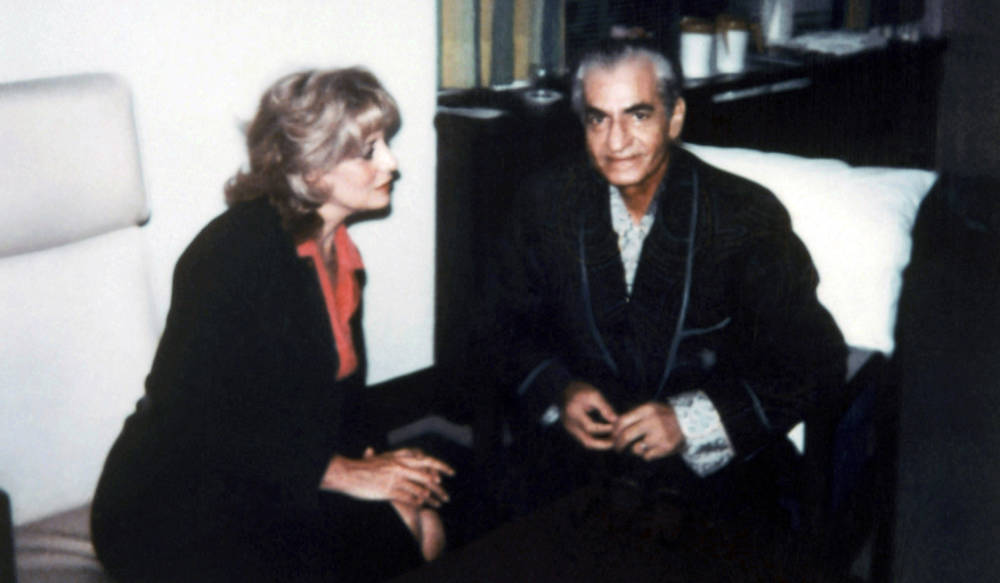
In a broadcast career spanning five decades, Walters interviewed an array of world leaders, including Cuba’s Fidel Castro, Britain’s Margaret Thatcher, Libyan ruler Muammar Qaddafi, Iraqi ruler Saddam Hussein, Russian presidents Boris Yeltsin and Vladimir Putin, and every US president and first lady since Richard and Pat Nixon.
“I never thought I’d have this kind of a life,” Walters said in a 2004 Chicago Tribune interview. “I’ve met everyone in the world. I’ve probably met more people, more heads of state, more important people, even almost than any president, because they’ve only had eight years.”
Walters’ critics said she too often asked softball questions and she was long skewered for a 1981 interview in which she asked Hollywood actress Katharine Hepburn what kind of tree she would like to be.
Walters pointed out that she only asked because Hepburn had first compared herself to a tree.
She knew how to ask tough questions, too.
“I asked Yeltsin if he drank too much, and I asked Putin if he killed anybody,” Walters told the New York Times in 2013. Both answered no.
Celebrity interviews also were an important part of Walters’ repertoire, and for 29 years she hosted a pre-Oscars interview program featuring Academy Award nominees. She also had an annual “most fascinating people” show but dropped it when she decided she was weary of celebrity interviews.
SPEECH IMPEDIMENT
Walters reached the top of her field despite difficulty pronouncing R’s — a trait that made her the target of a biting “Bawa WaWa” impersonation by Gilda Radner on the “Saturday Night Live” sketch comedy show in the 1970s. Walters said the spoof bothered her, until her daughter told her to lighten up.
Walters was born in Boston. Her father, Lou Walters, worked in show business as a nightclub owner and booking agent, and was credited with discovering such talent as comedian Fred Allen and actor Jack Haley, who would go on to play the Tin Man in the motion picture classic “The Wizard of Oz.”
After graduating from Sarah Lawrence College, she worked in public relations before joining NBC’s “Today” show as a writer and segment producer in 1961. She began getting air time with feature stories — such as a report on her one-day stint as a Playboy bunny — and became a regular on the program.
It was then that she began encountering resistance. “Today” show host Frank McGee resented her presence and tried to limit her role on the show.
After 13 years on “Today,” Walters was given an unprecedented $1 million annual salary to move to rival network ABC in 1976 and make history as the first woman co-anchor on a US evening newscast. Her unwilling partner, Harry Reasoner, made his disdain for Walters obvious even when they were on the air.
“These two men were really quite brutal to me and it was not pleasant,” Walters told the San Francisco Examiner. “For a long time, I couldn’t talk about that time without tears in my eyes. It was so awful to walk into that studio every day where no one would talk to me.”
After her unhappy run on the “ABC Evening News” ended in 1978, Walters established herself on the network’s prime-time news magazine show “20/20” and stayed with the program for 25 years. Being interviewed by Walters on “20/20” or on her numerous specials became a distinction — and guaranteed exposure — for her subjects.
In 1977, she scored a joint interview with Egyptian President Anwar Sadat and Israeli Prime Minister Menachem Begin before they made peace.
Walters became so prominent that her star quality sometimes overshadowed the people she was questioning. The New York Times called her “arguably America’s best-known television personality” but also observed that “what we remember most about a Barbara Walters interview is Barbara Walters.”
Critics sometimes found her cloying, but she also could be blunt, such as in asking Martha Stewart, the lifestyle guru who went to prison in an insider-stock-trading case, “Martha, why do so many people hate you?“
In 1997, Walters launched “The View” on ABC, a popular roundtable discussion show for women that was sometimes riven by disputes with her co-hosts Star Jones and Rosie O’Donnell. She made her final appearance as co-host of the show in 2014 but remained an executive producer of the program and continued to do occasional interviews and specials for ABC News.
Walters’ three marriages — to businessman Robert Katz, theatrical producer Lee Guber and television executive Merv Adelson — ended in divorce. She also had high-profile boyfriends such as Alan Greenspan, former head of the Federal Reserve, and John Warner, who would later become a senator from Virginia.
Her love life made headlines in 2008 when her autobiography, “Audition: A Memoir,” revealed an affair with then-married Edward Brooke of Massachusetts, the first black senator since post-Civil War Reconstruction.
Walters underwent heart surgery in 2010, which provided material for an ABC special in which she and former President Bill Clinton, actor Robin Williams and other high-profile heart surgery patients discussed their conditions.
She earned 12 Emmy awards, 11 of those while at ABC News, the network said.
DUBAI: Netflix is continuing its investment in regional content with the launch of its latest series “Scattered Barriers.”
Scheduled to air on Jan. 12, the Omani series features local talent Amina Abdel Rasoul, Ibrahim Al Zadjali, Essam Al Zadjali, Balqis Al Balushi and Raed Al Ameri, along with Emirati actor Salama Al Mazrouei.
It is directed by award-winning director Adbelbary Adulkhair — known for shows like “Dreams Drawn by Dust” and “Al Hasan and Al Husein” — and filmed by cinematographer Susan Lumsdon.
The series sheds light on the COVID-19 pandemic and its effect on human behavior and society.
The lead character, Nasser, is a taxi driver who denies the severity of the virus until he loses his mother to it.
The six-episode series is set in Oman but was shot in Al Ain in the UAE.
“Scattered Barriers” is the latest show in Netflix’s content strategy for the Middle East, with other recent examples being “Dubai Bling,” and “The Cage,” a comedy-drama and its first Kuwaiti series.
RIYADH: Vice Media Group is preparing to open its new regional headquarters in Riyadh’s Jax cultural district next month.
The new headquarters will offer clients a full range of production facilities, including a podcast studio, soundstage and editing suites.
The company said it aims to expand its presence in the region and bolster its relationships with key partners in the Kingdom, including the Ministry of Culture, Saudi Research and Media Group, the NEOM smart city development, media conglomerate MBC, and the Royal Commission for Riyadh City.
Tarek Khalil, managing director of Vice in the Middle East and Africa, said the company will hire local talent to join its new operations.
“Our enhanced operations in the Kingdom are truly a testament to our continued drive and focus to contribute to and be a part of the country’s dynamic youth culture,” he added.
Young Saudis — defined as those between the ages of 15 and 34 years old — represented 36.7 percent of the Kingdom’s total population in 2020, according to the General Authority for Statistics. This growing youth population, combined with Saudi Arabia’s investments in arts and entertainment in recent years, represents a potentially lucrative market for global brands that cater to such audiences.
According to Vice, the group brought its unique brand of journalism to the Middle East in 2017 and delivers content covering sectors such as culture, lifestyle and entertainment in multiple languages including Arabic, Farsi, Urdu and English.
With the opening of its new regional headquarters, the company, which also owns a creative agency, Virtue, seems to be positioning itself to play a role in the ongoing cultural and societal transformation of Saudi Arabia.
“Our unique storytelling capabilities and presence in the Kingdom will allow us to grow our business and support new and existing partners who are looking to tap into younger audiences and be part of the Kingdom’s cultural movement,” said Khalil.
DUBAI: Iran on Thursday shut down a decades-old French research institute in response to cartoons published by the French satirical magazine Charlie Hebdo that mocked the country’s ruling clerics.
Iran’s Foreign Ministry called the closure of the French Institute for Research in Iran a “first step” in response to the cartoons, which the magazine had billed as a show of support for anti-government demonstrations that have convulsed Iran for nearly four months.
The ministry said it would “seriously pursue the case and take the required measures” to hold France accountable. On Wednesday, Iran summoned the French ambassador to complain about the cartoons.
The shuttered research institute, which is connected to the French Foreign Ministry, was created in 1983 through the merger of an archaeological delegation dating back to the late 19th century and an institute of Iran studies. It includes a library boasting some 49,000 references, including 28,000 books.
On Thursday, there was a heavy security presence around the institute and the nearby French Embassy in central Tehran. Graffiti left on the outer walls — apparently by government supporters — referred to France as “the home of homosexuals” and a “place of blasphemy.”
Charlie Hebdo has a long history of publishing vulgar cartoons mocking Islamists, which critics say are deeply insulting to Muslims. Two French-born Al-Qaeda extremists attacked the newspaper’s office in 2015, killing 12 cartoonists, and it has been the target of other attacks over the years.
Its latest issue features the winners of a recent cartoon contest in which entrants were asked to draw the most offensive caricatures of Iran’s Supreme Leader Ayatollah Ali Khamenei.
One of the finalists depicts a turbaned cleric reaching for a hangman’s noose as he drowns in blood, while another shows Khamenei clinging to a giant throne above the raised fists of protesters. Others depict more vulgar and sexually explicit scenes.
Iran’s Foreign Minister Hossein Amirabdollahian on Wednesday vowed a “decisive and effective response” to the publication of the cartoons, which he said had insulted Iran’s religious and political authorities.
French Foreign Minister Catherine Colonna accused Iran of following “bad politics.’’
Iran “is not only practicing violence against its own people but is also practicing a policy of keeping people hostage, which is particularly shocking,” she said Thursday on LCI television.
“In France, not only does freedom of the press exist — unlike what happens in Iran — it is also exercised under the control of judges and an independent justice system, which is something that Iran undoubtedly knows little about. Also in French law we do not have the notion of blasphemy.”
She did not respond directly to the ambassador being summoned or expressly defend Charlie Hebdo. The French government, while defending free speech, has rebuked the privately-owned magazine in the past for fanning tensions.
Iran has been gripped by nationwide protests for nearly four months following the death in mid-September of Mahsa Amini, a 22-year-old woman who had been detained by Iran’s morality police for allegedly violating the country’s strict Islamic dress code.
Women have taken the lead in the protests, with many stripping off the compulsory Islamic headscarf in public. The protesters have called for the overthrow of Iran’s ruling clerics in one of the biggest challenges to their rule since the 1979 Islamic Revolution that brought them to power.
Charlie Hebdo, which has published similarly offensive cartoons about dead child migrants, virus victims, neo-Nazis, popes, Jewish leaders and other public figures, presents itself as an advocate for democracy and free expression. But it routinely pushes the limits of French hate speech laws with often sexually explicit caricatures that target nearly everyone.
The paper drew fire for reprinting caricatures of Islam’s Prophet Muhammad that were originally published by a Danish magazine in 2005. Those cartoons were seen as sacrilegious and deeply hurtful to Muslims worldwide. Islamist groups around the world organized demonstrations, many of which turned violent, as well as boycotts of Danish products.
LONDON: The UK government confirmed on Thursday that the free-to-air public broadcast television network Channel 4 will not be privatized.
The network, which is independently operated by the state-owned Channel Four Television Corporation, will remain under public control.
However, it will undergo profound structural changes to support its long-term sustainability and growth, the Department for Digital, Culture, Media and Sport said.
“Channel 4 is a British success story and a linchpin of our booming creative industries. After reviewing the business case and engaging with the relevant sectors, I have decided that Channel 4 should not be sold,” Culture Secretary Michelle Donelan said in a statement.
“This announcement will bring huge opportunities across the UK with Channel 4’s commitment to double their skills investment to £10 million ($12 million) and double the number of jobs outside of London.
“The package will also safeguard the future of our world-leading independent production sector. We will work closely with them to add new protections such as increasing the amount of content C4C must commission from independent producers.”
The move was anticipated on Tuesday when a letter by Donelan advising Prime Minister Rishi Sunk against the controversial privatization plan leaked to the public.
The announcement comes after months-long discussions with Channel 4 and the independent production sector.
As part of the package of new measures, the DCMS said Channel 4 will increase its commercial flexibility and investment in skills and jobs across the UK.
The network will also enjoy greater decision-making power over its own content, and a new statutory duty on its board members to protect the broadcaster’s long-term financial sustainability.
Alex Mahon, chief executive of Channel 4, was said to be “delighted” about the decision, and promised that the network’s impact will continue to grow.
She said: “The principle of public ownership for Channel 4 is now set for the foreseeable future, a decision which allows us to be even more of a power in the digital world.
“Channel 4 is innovative, editorially brilliant, and loved by audiences that others don’t reach, most of all the young and underrepresented.
“In the analogue world, we did this spectacularly; now, in the digital era, we are doing it again.”
LONDON: Amazon.com Inc’s layoffs will now increase to more than 18,000 roles as part of a workforce reduction it previously disclosed, Chief Executive Andy Jassy said in a public staff note on Wednesday.
The layoff decisions, which Amazon will communicate starting Jan. 18, will largely impact the company’s e-commerce and human-resources organizations, he said.
The cuts amount to 6 percent of Amazon’s roughly 300,000-person corporate workforce and represent a swift turn for a retailer that recently doubled its base pay ceiling to compete more aggressively for talent.
Amazon has more than 1.5 million workers including warehouse staff, making it America’s second-largest private employer after Walmart Inc.
Its stock rose 2 percent in after-hours trade.
Jassy said in the note that annual planning “has been more difficult given the uncertain economy and that we’ve hired rapidly over the last several years.”
Amazon has braced for likely slower growth as soaring inflation encouraged businesses and consumers to cut back spending and its share price has halved in the past year.
The company began letting staff go in November from its devices division, with a source telling Reuters at the time it was targeting around 10,000 cuts.
Arab News reached out for comment and what would be the impact of the cuts on the MENA region but the company said that “at this point in time there is nothing more to add.”
The tech industry shed more than 150,000 workers in 2022, according to tracking site Layoffs.fyi, a number that’s continuing to grow. Salesforce Inc. said Wednesday it planned to eliminate about 10 percent of staff, which numbered nearly 8,000 as of Oct. 31.
The reversal of Amazon’s fortunes has been stark. It changed from a business deemed essential during the pandemic for delivering goods to locked-down homes, to a company that overbuilt for demand. Its layoffs now surpass the 11,000 cuts announced last year by Facebook-parent Meta Platforms Inc. .
Jassy’s note followed a report in the Wall Street Journal that the reduction would be more than 17,000 jobs. He said Amazon chose to disclose the news before informing affected staff because of a leak.
Amazon still must file certain legal notices about mass layoffs, and it plans to pay severance.
Jassy said, “Amazon has weathered uncertain and difficult economies in the past, and we will continue to do so.”
With agencies