THE WOLF STREET REPORT
Imploded Stocks
Brick & Mortar
California Daydreamin’
Canada
Cars & Trucks
Commercial Property
Companies & Markets
Consumers
Credit Bubble
Energy
Europe’s Dilemmas
Federal Reserve
Housing Bubble 2
Inflation & Devaluation
Jobs
Trade
Transportation
Amazon made the news today on reports based on sources that it would be laying off up to about 10,000 full-time employees, less than 1% of its global workforce of 1.5 million; after Meta said it would lay off 11,000 people, about 13% of its workforce; after Twitter laid off 50% of its 7,500 employees globally and, in a second wave this weekend, cancelled 4,400 to 5,500 contractors. This comes after months of small-scale layoffs in “tech” – and “tech” these days is anything that does part of its business online, from used-car dealers (Carvana) to taxi enterprises (Lyft).
For example, Twitter. It has offices around the globe. Its 50% announcement included its staff in India. It had over 200 employees in India, and over 90% were laid off.
Then there are H1-B visa holders. Tech employs large numbers of them. Twitter did not specifically address that, but Meta did. They have only a certain amount of time to find another sponsoring employer, and if they cannot find one, they will lose their visa status and have to leave the country.
Twitter also laid off 784 workers in San Francisco, where it’s headquartered, according to Worker Adjustment and Retraining Notification (WARN) Act filings with the State; it laid off 106 employees in San Jose; and 93 in Santa Monica.
According to WARN act fillings with Washington state on Monday, 208 Twitter employees were laid off in Seattle. The layoffs are scattered all around the US and the globe.
The estimated 4,400 to 5,500 contractors that were cut this weekend were based all over the world, including India.
Twitter adopted work from home as the permanent approach. Employees who used to live in San Francisco before the pandemic might have moved to inland California or other states. Others might have turned into digital nomads, working in some tropical paradise.
Meta too had switched to working from home for many employees. Of those 11,000 employees that Meta is laying off, 362 will be from an office in San Francisco, according to Supervisor Matt Dorsey, citing a WARN Act notice that the City had received.
In total, about 2,564 of the 11,000 global Meta layoffs will be in the Bay Area, according to WARN Act notices with the California Employment Development Department.
That’s were those jobs were located. But maybe not where the people are located. It doesn’t mean that these employees were actually living in the Bay Area. Some might have moved inland California or to other states, and some might be working out of Mexico or Thailand or wherever.
Amazon is an ecommerce retailer and brick-and-mortar retailer with its Whole Foods Market stores; it’s also a tech company because of its cloud division, AWS. But it’s not laying off at AWS.
According to the report, first published by the New York Times, and then by others, including The Wall Street Journal that then cited their own sources, the cuts will mostly be corporate staff, not warehouse staff. A big part of the layoffs will be in Amazon’s retail division, human resources, and in its devices division, which makes the Alexa smart speakers among other gadgets, and has 10,000 employees. The retail division had already imposed a hiring freeze in October.
Since Q1, Amazon has been whittling down its massive 1.5 million global workforce through attrition by roughly 78,000 jobs. And attrition came easy, given the massive churn in the labor force in general, the huge number of people who quit jobs to take better jobs, and the huge number of job openings that companies were aggressively trying to fill. Job-hopping has been richly rewarded: While the pay of job-stayers increased by 7.7%, the pay of job-changers jumped by 15.2% in October, according to the ADP National Employment Report.
And the layoffs of up to 10,000 people at Amazon are minor compared to the 800,000 people Amazon hired helter-skelter during the pandemic boom – from the end of 2019 through the end of 2021 – the biggest boom ever for ecommerce. And it’s just that some sanity is returning to management.
Over the past few weeks, Amazon has already been cancelling contractors that work in recruiting, according to sources cited by the WSJ.
There is now a long list of “tech” companies that have been laying off people. Mortgage lenders have been laying off since late last year when their business of refinance mortgages began to vanish [read, Mortgage Lender Woes]. If you’re looking for a job in mortgage banking, it’s going to be tough. But there are lots of other jobs available in finance.
And layoffs don’t mean that these people won’t be working. Many of them get flooded with inquiries by recruiters – though the jobs may not be as highly compensated as what they had at Meta or Twitter or Amazon.
There are lots of non-tech companies that are aggressively looking for tech workers: Automakers that are hiring like maniacs for their new EV divisions, industrial companies, smaller companies, etc. They have been muscled aside by Big Tech with its huge salaries and massive stock compensation packages.
These less glamorous companies have lots of tech jobs they need to fill, and had trouble filling, and now they’re breathing a sigh of relief because they have a better chance of being able to hire talent, though those former Amazon, Twitter, and Meta workers may complain about how inferior those jobs would be compared to their former jobs. But that’s the kind of thing that brings some sanity back to this most contorted job market ever.
Enjoy reading WOLF STREET and want to support it? You can donate. I appreciate it immensely. Click on the beer and iced-tea mug to find out how:

Would you like to be notified via email when WOLF STREET publishes a new article? Sign up here.
Email to a friend
I spent the bulk of my career at non-tech Fortune 500 companies on the East Coast before relocating to a tech company in CA a few years ago. 95% of my network is still at non-tech companies. I am very worried about my job so I have started reaching out to my network to try to find backup opportunities. So far no one is hiring anything comparable.
The people I have heard from who were laid off at the tech companies in this article aren’t even getting phone screens. That could just be a numbers game but I have also heard that companies may be leery of hiring them knowing they will jump ship in a year or 2 when the economy rebounds.
I understand this is all anecdotal and the job opening numbers are what they are but that’s what I am seeing from my perch in the Bay Area.
If you worked at Meta and made $200k a year plus stock options as a 30-year-old, and Ford’s EV division offers you a job, you’re going to get a pay cut. That’s how it is. Meta was a gravy train that ran out of fuel. These rich compensation packages aren’t available at many other companies. But you can still make a very good living there and maybe have a great career.
So a lot of times when these laid-off tech workers say they cannot get any good job offers, that’s what they mean. They think that the next job should always pay more than the prior job. But that’s not always the case when a bubble bursts.
“So a lot of times when these laid-off tech workers say they cannot get any good job offers, that’s what they mean. They think that the next job should always pay more than the prior job. But that’s not always the case when a bubble bursts.”
Now that the tech bubble is finally bursting, I think this is just the beginning and a huge amount of tech jobs will simply disappear. This is just my opinion, but I think that a lot of what constituted tech work in the past few years was completely pointless.
For example, we can look at Facebook, who went through maybe ten redesigns in the past five years, none of which brought anything truly valuable to the platform. As far as I observed, a lot of companies did the same thing with their websites, basically paying far too many people, far too much, for far too little value.
Let’s not even talk about mobile apps market, where there are already applications for basically anything you could ever imagine and it is doable, and there are also five copycat apps for every one mentioned above. What is there left for the tech guys to do, besides changing colors and moving buttons around? How many people does one actually need to accomplish this?
There are also huge amounts of people that are in training to go into tech, chasing the huge wages to be found in there, there are a lot of people being laid off, there is less tech work to be found because of startups going bankrupt left and right, now even the big guys are firing. I think a lot of tech jobs will simply vanish, and a lot of former tech guys will have to find a new career.
I failed to mention the crazy crypto market, soon to crumble into nothingness, along with that juicy tulip money that created so many tech jobs and crazy wages.
Crazy what happens in a cheap money environment.
Looks like we’re about to have a worldwide unemployment block party.
Yes. Much of the QE and extra credit from ZIRP ended up in the hands of the big tech companies, so the salaries they were paying were not realistic.
It’s the same for houses, which are still listed at prices that made sense at 3-4%, but not at 7%. Labor is something to be bought and sold like anything else.
This post has a “640k of memory ought to be enough for anybody” vibe.
Technology is still the future; it is not going to stop and stand still in time. This setback is a necessary correction to overgrowth, but to suggest that Meta engineers are suddenly going to need to find a whole new career is laughable doom-wishing.
Sorry, these “lazy” workers get to work from the comfort of their homes on large salaries because they’re incredibly smart. Seems like FOX News has been successful convincing you a fellow citizen doing well should be reviled, but not the exploitative billionaires like Bezos and Musk.
I agree that this is not just a temporary setback for tech workers. Having been in the field myself for over 20 years, it has gotten oversaturated with candidates. A lot of tech jobs are BS, and to your point on a big pipeline of new candidates, every university now seems to have a cyber security program.
I think even cyber security jobs will be harder to find over the next several years. I am actually in the process of re-inventing myself to get into a lower paying but more meaningful line of work. I have lived below my means and have support from my wife for this, fortunately.
I’ve been in IT for over 25 years. I remember in the early 2000’s folks who had IT jobs that shouldn’t have them. 2008 took care of that. I moved out of state and basically took less money to do it. It was tough for me to find work in 2009-2010 with 15 years of experience, what do you think happened to folks who didn’t really know what they were doing?
I worked for Kmart HQ in Troy MI. Made $70K plus a bonus at the time. Layed off in 2004. Dropped to $60K to move to Nashville TN. That was a foothold job because I was able to shift two years later for more. Now I’m at $130k and could go much higher if I made another move, but I don’t want to. (I’m InfoSec/Cloud Security) I work for a stable company that treats us decent, so I’m playing wait-and-see.
I’m also remote and live two hours from HQ. I’m supposed to be a permanent WFH, but they wanted us to start coming in a couple of days a week and I said no, that wasn’t our agreement. (All of my leadership has changed since I came on board.) So we compromised and I only go in once a quarter for their rah-rah meetings. So there is that tension in some companies. Had they held their ground and tried to make me come in more, I would have left even with all of this uncertainty.
>Facebook, who went through maybe ten redesigns in the past five years, none of which brought anything truly valuable to the platform
Valuable to you as a user, not so much. Valuable to Meta, yeah, they made a lot of changes to improve retention, stickiness, etc, all of which gets to what they really wanted: ad impressions and attribution.
It’s been said a billion times, but that doesn’t make it less true: when the product is free, then YOU are the product.
This tech purge happened back in the 70s and I lived through it due to some contacts and some luck. But there were a lot of new real estate agents.
But think of the ads.. who’s going to shove the poor ads down the consumers parched throats? How long until consumers revolt for lack of ads to wash their smooth brains? /s
You are pretty much spot on regarding the number of copycat apps.
I’ve been reviewing Zapier tie-ins and a *lot* of program types are 5 to 10 apps deep in terms of essentially identical functionality.
(I’m kinda surprised that people smart enough to program a spreadsheet app aren’t smart enough to find out ahead of time that 6+ others already exist…)
That said, the tiny little optimist inside of me says that potentially useful programs are potentially infinite – it just takes insight and creativity…there clearly seems to be enough programming talent.
(There is room here for a post on today’s speedy snap-together programming paradigms – frameworks, libraries, GitHub, etc – but I’ll leave that to the experts on the board…)
This is what happens when credit conditions tighten significantly. This is just the beginning because there has bene no significant tightening, not even close.
The bond mania is over, ending in 2020. Credit conditions are just starting to reflect this end, starting with “peripheral” sovereign and corporate debt along with sub-basement credits in developed markets, including the US.
It won’t be a one-way street, but this is just the beginning. This will last decades, not years.
Gen-X and Gen-Y Americans have never known anything other than (sub) basement credit standards.
But SWE Josh says they’re not even getting phone screens.
So salary isn’t even in the picture yet.
I worked Y2K well into 2001
was on last 6 month gig when 9/11 hit
made it til spring 2002
—–
new wages were 1/2 and I ended my tech career
I re-invent myself each year and look for no fewer than 3 streams of income
they tend to rotate and that is fine with me
—
plenty to do – have a meeting to discuss strategy for coming crash in real estate
unlike 2008-09 when I was over leveraged and had to make lots of lemonaide
virtually all investments are debt free and cash flow nicely
Wolf you nailed it here. We have a huge group of tech workers who now set their baseline minimum salary to their last job. A tech recruiter previously making $175K when everyone else is paying $90K? Also, that same worker has a $4K mortgage and $800 car payment to make! Downsizing into a smaller house and a Chevy isn’t in the cards.
I anticipate as a result we are going to have a mismatch of workers to job openings for the time being until folks can adjust their hubris to match market opportunities. I believe Meta’s layoff was 4 months + 2 weeks/year additional severance. We have at least 6-8 months before those folks become really desperate.
And, as Mark Twain once remarked, “Don’t go around saying the world owes you a living. The world owes you nothing. It was here first.”
Prairie Rider, great quote, wrong citation. Try Robert J. Burdette.
😉
Good comment little modal!!!
Been there, done did that exact same program years ago, and in spite of my career in another industry after my main ”mentor” encouraged me to get out and stay out of ”tech” in 1968,,,
Just one more iteration of the challenges of the ”global” economy.
Hope all the folks in India and other places will be OK, and IMO, most all in USA will be able to find both food and medical services, free and/or SO damn cheep they will still be able to buy the drugs of their choices…
I know of a computer coder who quick his job and went to work for Spotify. I guess part of the deal was a $250k RSU besides a salary increase. SHOP stock was about $130 at the time and it is now $40ish. I am guessing this is not the only such story.
That 1st year of the 5 years of RSU stock may not amount to much but the next 4 years may turn out okay.
Oil business in 2008 I took a 60 percent pay hit that never returned and did not hesitate to change before the layoff . I’m too am confused by folks that don’t take steps to stay working.
more stimi please
does that help
As a hiring manager during my career, the first interview question I posed was, what do you want to know about the job and benefits we are filling? It is shocking how many started off with vacation days, personal time off, then benefits and what are the advancement channels. Some just blurt out “salary”? The content and requirements of the position or qualifications or culture seldom mentioned.
Any candidate asking about time off was eliminated at that point.
@CreditGB
Sounds like a major boomer “I walked uphill both ways to work” comment. Seems like you think employees should be your indentured servants grateful to you oh mighty hiring manager. “How DARE they ask me about benefits, they should accept the job and find out later, grateful for whatever I give them.” Never underestimate the smallest amount of power that goes to a middle manager’s head. You probably are the type to shame employees for taking their time off.
Employees valuing the benefits given to them should not eliminate them from contention. Work-life balance is something we should all strive for, and if it is a benefit being offered, there should be no problem entertaining a question about it. Maslow’s Hierarchy of needs, if someone has kids, a family, or just wants to take care of their work-life balance, and have psychological safety, they are more likely to bring their full selves to work and perform their best. Decades of OB study has confirmed this.
A good manager should be able to manage the inputs and outputs of their department, and measure productivity in many ways that are not “bodies in seats in person”, nor “hours of your life given to me”. If someone takes advantage of their benefits-granted time off, but meets deadlines, communicates well, and outputs quality deliverables, I do not care if they take their three or four weeks a year off. If I eliminated the quality candidates that I hired that asked about such benefits, I’d have lost out on some of my best talent, that has loyally worked here and put in major overtime when needed.
I say this as a member of senior management in a large organization with my own vacation time expiring over my cap. I do not care about bodies in seats, nor time off. I measure productivity and performance in much more meaningful and accurate ways.
AGREE totally, in spite of your handle on here:::
WAS willing and did travel for many years in construction industry AND had very good ”pay” growth the entire time, from early ’60s to mid ’19.
Some younger folks, including especially boomers need to understand, ”YA GOTTA GO WHERE THE JOBS ARE.”
Certainly NOT so clear with the WFA concept and possibilities based on WWW connectivity,,, but IMO, that will become very challenging soon.
There is a great difference between Amazon/AWS or Microsoft vs. Twitter or Meta and the type of tech workers they employ. While the former provide a comprehensive Cloud development platforms and methodologies to build any business solution on wide array of technologies, the later are companies that are running a specialized application with a small set of simple functions. The former are software engineers, the later are coders. Adults vs. children. On average. Hire wisely.
lots of coders are from Twitter
Electroneuter, great line!
“The former are software engineers, the later are coders. Adults vs. children.”
Amazon closed 20 warehouses and cancelled plans to build 20 more.
According to the BLS 261,000 jobs were added in October. The unemployment rate rose to 3.7% as more people started looking for jobs.
200K for a thirty YO in tech is hardly exorbitant. It’s barely an UMC figure. Another blow to the middle class.
Many youths are now eschewing STEM degrees. Too much brain work for uncertain rewards.
Better STEM degrees than law degrees.
“So a lot of times when these laid-off tech workers say they cannot get any good job offers, that’s what they mean. They think that the next job should always pay more than the prior job. But that’s not always the case when a bubble bursts.”
Exactly. During the Boom times of last 2 years, some were making 200K salary plus another 200K in stock RSU’s. It was very tempting to take a new job when companies are hiring warm bodies at that compensation. I had one co-worker who planned on driving his RV to Silicon Valley and living in the parking lot during this boom. He was going to bank most of the salary and buy a house with cash elsewhere during the next crash. We’ll see how that goes.
It took 5-10 years to recover the salary tech people were making during boom times after a crash. If you are old, you may never get back into the game until the next boom as long as you are still a warm body.
The oldsters like me, have gone through this twice. 2001 and 2008.
The trick is not to increase your spending to the level of your salary during these times and bank the difference.
Some increased spending is unavoidable. If you purchased a house in the last 2 years, I hope you took the compensation windfall and rolled it into the down payment and didn’t push the monthly mortgage to the limit. Buying a mansion with 10% down because you qualified with a 400K/year salary never worked out long term in 2001 or 2008.
Correction:
Buying a mansion with 10% down because you qualified with a 400K/year salary never worked out long term in 2001 or 2008.
It worked out in the 10-15 year long term as long as you could keep paying the mortgage. Often at half-salary.
Another point.
Many smart companies gave their employees stock RSUs instead of raises during the last few years.
If the company stock went up 10X, many employees were making 400K+ in total compensation with a 150K base salary.
If now the company stock has plummeted 90%, they are lucky if they are making 200K.
I think that is fair to the employee if their hard work raises the stock price and was fair to the company during normal times.
It is hard on the employee if they expected this windfall to go on forever and they stretched to purchase a house beyond their base salary.
At the risk of ranting even more, during the 2001 and 2008 crashes, some conservative people didn’t follow 2 basic tenets:
1) Don’t put all of your eggs in one basket.
2) Don’t count your chickens before they are hatched.
Back in 1999, when Lucent stock hit its peak, I knew several long-term, loyal Lucent employees whose company stock holdings far exceeded half of their net worth. The stock proceeded to plummet from $128 down to $1 during the DotCom crash. 99+% decline. Half of these employee’s net worth disappeared.
Some were counting on this to pay off loans on houses, boats, RV’s and to retire.
The truly unlucky ones lost half of their net worth and then were laid off.
Even though I am loyal and believe in the company I work for, I wouldn’t hold that much even in my company stock.
Our stock hasn’t crashed yet, but I know a few co-workers who are holding a massive amount. They have done very well the last 3 years. For now.
If you are holding any one stock or Crypto, make sure all of your eggs aren’t in one basket.
Also, see Enron.
Save and scrimp by when the picking are good. Trim all the fat off when times are bad.
I did a small oopsie last week at my decent paying but great benefits company. It’s one and done in the trucking world usually. I do go above and beyond here and there but I’m probably done for, with the immense tracking of CDLs and whatnot my license is probably chopped liver for 3 years if I get let go since it’ll be a DAC, PSP, MVR incident and trucking insurance companies have draconian hiring standards for companies. Less than 1500 in damage. Might have to start a whole new career from scratch making half what I make now for something minor. First and only ticket in 6 years in the road. Doesn’t matter unless you’re at a mega who self insures; and I’ll work digging ditches before I work for another mega carrier again. Unless it’s the UPS LTL gravy train.
The overall lesson though is, as always there’s no free lunch. A degree-less 20-something year old nowadays is a bad spot to be in. Most means of making a middle class income either destroy you and your personal life or are very stringent in their rules and terminations. Very low demand for holders of nothing but a high school diploma or GED.
But even with that considered, I knew it was likely borrowed time so I have no debt at all, didn’t buy a house, didn’t start a family, didn’t party with friends and women, got all my dental, medical, and vision done as best I could, and don’t even have a lease. Just word of mouth, month to month room rental. Thousands in the bank ready to go and nearly 100k in investments I could liquidate. Not too shabby for a late 20s millennial with limited job prospects. I can comfortably last 5+ years unemployed living indoors and change little to my lifestyle.
It simply amazes me how someone could be making 200k a year and not even be fired yet and be freaking out about money. If I was making 200k a year; sure, I’d buy a house at some point but it would be a cheap start home under 2k sqft outside of town. Not in a housing bubble of course. But those guys have some stability, “tech bros” can always fish in another pond, their skills and experience can’t be just wicked away like a DAC report, or a contractors licensing, policeman’s badge, lawyers bar certification, etc. It’s a smart line of work to be in. Some well paying careers can go up in smoke over a single mistake.
Always pays to be on the defensive.
Good points and good luck with the outcome.
Hopefully forgiveness comes easier with a high demand job.
Trucker,
Saving is definitely the smart thing to do…savings=freedom (from worry, ahole employers, etc.).
But one small defense of those Silicon Valley spenders.
N. California home prices are so insane (even 80+ miles out from employment centers) that it is very easy to be compelled to lay down $500k for a house, any house.
Of course, the smart thing to do is to write off SFH as an option…but rents are insane too.
The only smart option is the one mentioned above…save *everything* for 3 or 4 years, live in a van down by the river, and get the hell out.
But that doesn’t gibe with most Americans’ idea of “normal”.
But the truth is that American “normal” died decades ago.
Good.
Layoff the entire workforce. Frankly I couldn’t care less if META, Twitter and even Amazon went out of business tomorrow. I don’t use any of them and Amazon is on my sh$t list because of 4 or 5 incidents of hacking of my credit card and other irregularities. I’m boycotting them, including all of their subsidiaries. Bezos is now trying to buy the Washington Nationals baseball team and the Washington Commanders football team. You’ll soon have to buy Amazon’s streaming service to watch a football game.
i am in tech.
i have candidates 3 years out of college asking for 200K base. good times.
though what i see now is lots of people get hired quickly. we are still early in the process.
What Wolf says! When the economy starts downsizing you have to be prepared to take a pay cut in order to survive.
Another anecdote from my brother’s mortgage career is that when the economy is downshifting, it does so in stages. Companies will make a big headcount cut due to “market conditions”… and promise everyone who is left that they are safe. But often times that is just Happy Talk… the people who jump ship first (by choice or mandate) to safer jobs are the ONLY ones who will even have jobs when it all truly does Go to Heck.
My first hand experience is similar. Been looking to move for some time now, no luck. Not looking for more money or anything, just need a change of scene. I am not sure where these aggressive hiring is going on.
[Content deleted by WOLF including the name of the site]
Cas127,
The site you raved about with a huge amount of silly BS and that you linked is a DEAD site. The last entry is from 2015. And you were trying to tell our readers to go there to get current data and charts. This BS drives me nuts. LOOK at the crap BEFORE you rave about it and link it.
Speaking of pixel jockeys (I mean tech workers), I heard Waymo? just got the ok to run a few self-crashing cars around SF sans human back-up. From local news, I think. True?
Should be interesting what happens, even if they stick to very well practiced and object stable routes, which is likely.
No, I don’t think there is any such thing as AI. Still just algos and memory like it always was, just more and faster both.
And better sensors (resolution) and faster solenoids, stepping motors, etc.
We already have some Cruise models (GM) running around without driver, with and without passengers, in one incident 7 of them suddenly showed up together at an intersections and stalled, blocking traffic for hours, etc. Coders have a funny sense of humor.
I don’t want paint with too broad of a brush, but a lot of these people were just milking a paycheck and doing little to nothing to earn it. What constitutes “work” these days is pathetic in many instances.
I learned several decades ago to never hire tech people terminated in the first round of company layoffs. Wait for the second or third round. First-round tech layoffs are usually poor performers.
Agreed. Until the economy softens enough whereby layoffs hit a broad range of companies, then what we’re seeing today is just niche and nearly pointless to talk about. It’s bad for those, of course, losing their jobs, but it won’t have a meaningful effect the desperately needed reset in home prices.
Sure, it will help curb inflation just a tad more, but what’s needed is a 30% drop in home values. Without that, we just come out on the other side with the same overinflated home prices. And I can’t home prices moving much higher, if the 30YFRM stays above 5%.
The Fed needs to get out of the business buying anything beyond 5Y treasuries. To do so allows them to manipulate the long-end of the yield curve which is exactly why we’re in this problem and everyone knows it. It’s all about housing. Jobs are simply the means to reduce home prices.
The decision by the FED to continue buying those MBS in the face of the largest housing bubble in history was the most corrupt, reckless and diabolical policy in history. To be driving shelter prices out of reach for the working class and the poor is despicable beyond words. There’s a special place in hell for Powell, Yellen, Bernanke and Greenspan. These people are truly evil.
DC
They not only destroyed the country, they destroyed and are continuing to destroy the world.
Old news as this has been coming down the pike for years now.
Just no real value with these companies that I can see.
Besides the run up bubble.
Only thing left is the communications, and certain services like cement, sewer, hog farming.
We’re *** beyond belief.
-S
Saying there is “no real value with these companies” seems a little odd as Meta did make a profit of $4.39B in Q3 of 2022. Certainly there are companies like Uber that have never turned a profit but some of the companies laying people off are just doing because they are making less profit, not because they are not making any profit.
I just don’t believe there value going forward.
We’re getting there quickly.
The WFH people are in the crosshairs of all companies.
It depends. I have such a job and it is critical to my employer. There is no going back for them due to the simple reason that the space they used for the call center before moving to a WFH model has now been allocated to another critical division of the company.
You are assuming hiring/firing/wage decisions at companies are fair, and based on merit. That’s far from how the world actually works. Look at what just happened at Twitter where external reviewers came in and made cuts within a few days. Very few people understand the subtle contributions some of those employees made across the orgamization. I’m 100% certain a good chunk of people were let go that should have been retained, and that a large number of “bottom feeders” kept their jobs.
Industry depending. In large parts of administrative healthcare (a much bigger niche than you’d think) there’s no need to keep paying office space, utilities and such when all work can easily be done from a laptop. Many companies were WFH or mostly remote 12 years before the pandemic. And they are still desperately hiring. Productivity and location is heavily tracked, but do your job and its not a big deal.
Don’t think so yet… may WFH in tech but not in the non-tech areas. CIO is vigorously defending WFH at the moment. Of course these individuals turn on a dime and would sell their mother for a quick buck, so can’t take their word for mich.
Denial is legion among the WFH contingent, who enjoy their set up. But consider this: a manager has two employees who both do the same job for the same pay. The Fed’s rate increases finally trickle down and the VP says his team needs to do more with less. Who’s the manager gonna let go? His cube neighbor who has pictures of his family atop the file cabinet and who loves to talk local football or the guy calling in from an Idaho resort town?
Nice imaginary scenario you’ve created there.
If I have to cut part of my team, I am doing it based on performance. I could not care less who is in the office and who isn’t. Anyone under 50 should know how to measure productivity of WFH employees effectively.
The era of the middle manager that just keeps track of tasks without subject matter expertise (and gives preference based on non-performance factors) is over. WFH exposed who can manage effectively, and who cannot.
Methinks thou doth protest too much.
“Anyone under 50 should know how to measure productivity of WFH employees effectively”.
B.S. You’re probably well under 50 and think you know what’s up. You clearly don’t.
Measuring performance is notoriously difficult, and there are entire PhD theses and seminars and textbooks and consultancies and you name it dedicated to that topic. Most managers are SH*T at hiring and SH*T and measuring performance.
WFH just adds another variable to that challenge.
Some WFW (WFWherever) workers are awesome, some suck, some are under-appreciated, some are over-appreciated.
You just don’t get it. You think you do, but nahhhh.
sc7, it’s not about you, it’s about human nature. Yeah, yeah you’re a great person and only performance matters no matter wfh or not.
But human nature says the vast majority of managers will get lay off the guy they don’t see every day, keep,the one they do lunch with. Simple fact of life based on odds.
And I say this as someone who wfh for 20 years. But there’s no one else who can do what I can do at this point, so no one in the office to compete, I’m good until my little niche doesn’t need anyone like me. That’s how you keep wfh.
Not to sound arrogant.
My old manager once looked at me and said: “I like work from home employees, they are much easier to let go”
Ten years later, I’m still here and he is long gone. His nice corner office with plush carpet is now a conference room.
i think he pissed off more people than his employees.
I predicted WFH people would be the first to go in any downsizing. I was correct. It’s easy as 1 2 3. Just cut their log on off and they are gone. NO awkward face to face meetings.
So these are the big established companies in tech doing some moderate shedding and most of their layoffs are absorbed into other parts of the economy so far. What about the numerous startups and “zombie” companies who exist only to burn cash I’ve been reading about here? I imagine most are holding on for dear life ATM while they still can but that seems like it will end at some point in the near future and the shedding for them should be the entire workforce in that case. How large of a workforce is at risk there and how long until they run themselves into the ground?
They are sleeping on concrete.
No, the ATM is closed.
That’s a good question, I have a followup. The “investors” that gave these zombies the money, don’t think they are the saintly type. So what happened to their money. Will we see a real life version or Stewie standing over Brian yelling “where’s my money”.
I’m seeing a big ol’ nothing burger cooked up in this particular Wolfstreet article. That may change over the coming year and this article could become prophetic, but there’s just nothing surprising here for the time being.
Amazon is surgically shedding a tiny portion of their employee base, but still hiring in other parts of their business. Meta’s layoffs are basically due to their leader making bad decisions dumping billions into what is probably a lost cause. Nothing new… A virtual reality life has been just around the corner for at least a few decades, but it never catches on. The history of computing and gaming is littered with a mountain of failed VR projects. Meta’s problems aren’t hinged on a weakening economy per se. Twitter is shedding tons of dead weight to maybe have a hope of breaking a profit one day (or failing entirely). But again, it’s a business model problem, not clearly a matter of a slowing economy.
There are lots of tech zombies out there and the vast majority of them will fail, but the vast majority are also very small. They may have had large peak valuations during the boom, but when they collapse, most of them will only leave behind a couple hundred or a couple thousand employees here or there at worst, and that will be spread over the next year or two as they come to the end of their runways. The tech collapse won’t be enough to make a real dent by itself. Tech-hubs like SF and Seattle may be profoundly affected, but it just won’t be a big problem in most places.
We won’t see any real carnage unless the economy slows enough to start hurting large profitable companies that make and/or move tangible goods or provide valuable services.
Not Sure,
“I’m seeing a big ol’ nothing burger cooked up in this particular Wolfstreet article.”
RTGDFA
You have no idea what the article says. And then you think you contradict what you imagine the article says, but in effect repeat what the article says.
I have not idea why you have to comment here on the article if you cannot RTGDFA.
Cash burn machines must collectively employ at least several million. I infer it’s a small proportion of the labor force but not insignificant at the margin, especially in specific job fields.
Most of these companies are destined to go bankrupt and probably disappear.
Up to 7% or so could just be companies disposing of klunkers/”deadwood” after a hiring surge. Not every employee is “a fit”, or valuable.
Some of the tech companies are pretty infamous for putting their employees on a “PIP” (Performance Improvement Plan) to manage them out. I believe Amazon has a mandated 6% PIP with only about 10% of people passing the PIP and rest getting fired. Employees can should to immediate take severance or try to improve over the next couple months before being fired if they don’t pass the plan. So these tech companies already have a well established way to get rid of ~6% of their employees which they could easily dial up. That does not even account for attrition which is surely less now that all the hiring freezes are in effect. So these layoffs feel different than the regular PIP process and seem to go beyond just getting rid of the low performers but are about exiting or drastically reducing entire lines of business (e.g. Amazon cutting back on Alexa, Meta discontinuing Portal devices for consumers, etc.).
No one survives a PIP. That is the point.
Disposing “deadwood” employees or “deadwood” tasks in the company?
The later may be a greater problem than the first and the undelying reason.
Been through the PIP process that makes sense at the HR level but not at a management level. Let managers manage staff and balance sheets and HR assist in the processes. Fortunately not all businesses are sustainable I love change and progress. Bill Gates one time in the 90s went looking for one of his sharper engineers and found out the engineer had left due to the PIP mandatory process that Walsh of GE was a big believer in and maybe created by MBA world. He was livid. Depends on the cycle of business one is in. During growth mode if employees are not performing then trim them and hire those that are. But not forced ranked in my option. Recruitment is expensive as well.
I agree.
If Amazon hired 800,000 people in the last 3 years and this is their first layoff, I guarantee up to 10% of those 800,000 people are dead or dying wood. That is 80,000 people.
Unfortunately, I have seen companies during hard times lay off 10% of their workers for several years. They are cutting to the bone with the assumption that they remaining workers will pick up and do their departed co-workers jobs if they want to remain employed.
That rarely works long term.
The smart companies cut entire projects along with employees and stay focused. They don’t keep all of the projects and burn out their remaining employees with more work.
It’s too bad Amazon isn’t dead or dying wood. I’d like to see Bezos disappear on his giant flying d!ldo forever. He is the epitome of everything that is wrong with corporate USA.
Bezos is the reincarnate of the Robber Baron of the 19th century.
When America was great from 1918-1982, a CEO couldn’t amass such a large fortune because 70%-90% tax brackets prevented it.
We have returned to the wild capitalism of the 19th century.
I am not a commie. 🙂
So called “robber barons” increased the standard of living for the lower classes more then anyone else in history. I know history likes to crap on them because they did most of it with their own money and no help from the government. Many times they were in direct competition with the government. And yea, they got wildly rich providing better more affordable goods and services. What a shame!
Imagine that you work for Twitter as part of an important team.
The company implements a permanent WFH policy. You move from SF to, maybe, Mendocino. Your team thrives, meets its objectives, all is well.
Musk buys the company, you survive the RIF, but now Chief Musk orders you to work in SF.
What do you do?
1) We are not in recession. The Dow is down only 8%. JP failed to
muzzle the Dow.
2) The Dow is a function of price. When XOM was down for two decades.
Saleforce replaced XOM. CRM is down from 300 to 150. CRM weight in the Dow index is 3%
3) Warren Buffet love AAPL, but the Dow don’t care. Goldman Sachs is down 7% from the top. At 380 GS weight in the index is more than twice as AAPL.
4) XLV is about 1/3 of our economy. XLV is down 5% from the top.
Unitedhealth is up to 550, x4 times the weight of APPL.
5) The Dow components is sort by weight. The weight of each member
is a function of price. The weight of UNH is 11%, GS is 8% and AAPL is 3%.
Michael,
Ever since G S alum Rishi Sunak became Prime Minister, Goldman Sachs has been on a tear. I expect it will continue.
I am a big believer in looking at dividend yield history of the sp500 and comparing to treasury yields of all durations. Dividend yield of 1.7% vs. 4% treasury yield and trending higher at the short end tells me sp500 is too high.
If you assume dividend growth on SP500 continues at 7% it will still yield less dollars annually than a 10 year by year 10.
We have been an outlier with Fed policy that sp500 yields 1% – 2% for the last 25 years.
Last few recessions the yield of 10 year and sp500 yields cross.
I’m curious about the companies that have debt that far exceeds revenue — companies that have been repackaged and resold over the years, taking on new debt every time, with that debt rolled over every time it comes due — now that interest rates have skyrocketed. This isn’t just zombie companies but even large, well-known companies (I can think of a couple in aviation).
Getting tired of this script, seems like the writers are just like Hollywood and can’t have an original thought. On to all time highs on the back of bad news?
Creepto down, creepto sucked liquidity, M2 is down since Apr 2022.
The shticky inflation is temp.
“Creepto,” for whatever reason, continues to catch all sorts of bids to prop it up. What the FTX PONZI did was expose some of the reckless gamblers, like “Mr. Wonderful.” Seriously, did this clown do any due diligence? He’s supposed to be some business soothsayer, “Shark Tank” and all, yet he got punked. Couldn’t have happened to a more deserving narcissist.
Pendulum is still too far toward risk on as Fed has people trained to buy the dip since long term capital debacle.
When pendulum swings all the way to risk off you will see Las Vegas closing casinos because people will not be throwing their money away for entertainment. Powell waited 9 months too long to take the punch bowl away. We are going to sober up fast once 4 -5% money works it’s magic.
All western oil co have lost their Russian assets forever. All but one. Whatever Russia cannot sell will stay in the ground. Bangor ME, Cherson and Kharkiv will freeze in the next few months. Nothing wrong with that, from the Russians point of view.
The red army might torture Ukraine with brutal electric shocks waves, changing the history of war fares.
“Juicy tulip money” I love this. Thanks Andrei.
After the Dot.com bust, I recall interviewing potential employees who had worked 25 years for one company who were specialized, for jobs that paid a 1/3 of their old salary and required diversified job skills.
Most simply weren’t qualified. They were working part time minimum wage jobs trying to support their families.
That is when corporations started getting rid of older expensive (wages plus benefits) employees.
After the Great Recession, at local employment workshops, no one suggested working for local tech jobs as all production had moved overseas and they recommended concealing your age as no one was hiring gray hairs, as the later were to expensive to employ.
The job market and career path isn’t the same as it was for the baby boomers.
It is no surprise job participation and employment rates have been declining. Now add in Ghost Quits. You can see why productivity is down.
Looks like we might get a massive blow off top in the stock market before the end of the year. More hair pulling by Powell?
At this point I am actually kind of hoping for new all-time highs. It will just further expose Powell and Co. as frauds. His “soft landing” rhetoric = no meaningful steps to combat the inflation inferno he created.
GOD, I hope so. That would be the most awesomely EPIC short opportunity.
And unfortunately, there may be just enough momentum money to make it happen.
Wouldn’t count on it. Lot of flimsy narratives behind these runups, to me that means the street is trying to unload their losers. Most flimsy of all is that recession/unemployment is going to be good for the economy. Someone explain to me how that works when earnings fall off a cliff?
> Someone explain to me how that works when earnings fall off a cliff?
Magical narratives had millions of Americans all-in. I now see these as foundational to this (decadent) culture, and mindsets. I am not ready to think vulnerability to magical narratives faded away. I think we are simply semi-paused, awaiting the next one.
Tom S, I too find this narrative of “bad news is good news for the stock market” absolutely hilarious. I can’t think of anything better than this to demonstrate how a couple decades of accommodating Fed bailouts has created some monumental moral hazard.
It’s about time some layoffs hit “tech” companies. For the past few years I have stood in awe at the amount of overhead these companies carry, and the pampering of their employees. While we in boring mature industries like durable goods manufacturing wrestle with the decision to fit a new engineer or new machine into the budget, or give a few percent raise, these managers live in a totally different reality.
It is easy to run a loss-making, cash-burning business. You just hit the big red easy button labeled “hire someone” to make problems go away. I think this has been the tech mantra for a while. They have had it too easy for too long, and it breeds complacency.
My grandpa ran a half-dozen businesses in his career, and passed down a lot of solid wisdom. A couple things come to mind seeing layoffs pop up here, especially at Twitter.
“In a sinking business, everyone still appears busy, and managers are usually paralyzed. They may even actively resist making real change, claiming it will never work. As a manager, it is your job to see that and reverse it when that starts to happen to you. Being busy is not an indication of value to the business”
He also said cost cutting through deep layoffs is very hard because of the people factor. But he said a business with a solid business model will come out on the other side fully energized since all that misallocated cash finds its way to more productive use very quickly.
Getting a tech job was/is almost like winning the lottery. To me, that isn’t a indicator of prudent resource allocation.
RG62….Very well said 👍 So many today are in awe of these so called “Tech Jobs” and the associated Tech Workers. Take a look at the occupants of Wolf’s Failure List. One of my favorites is Enjoy…. mobile retail store 😂🤡💸
Meta had Q3 profits of $4.4 billion. They are in no way a sinking ship.
But Zuckerberg wants to take the ship over the horizon chasing that white whale, the firm is now renamed for. I speculate he thinks the ship has sailed on future growth of the facebook thing.
Layoff and re-employment is just one cog in the wheel of cooling off an economy to reduce further inflation.
It is a process, not a light switch. This will need to play out over the next 5 years or more before the economy settles on an even keel and moves ahead.
CreditGB, US 10Y have reached it’s high plateau.
TY is up. When TY bear market rally will be over it will test Jan 2000 low,
down below.
I agree this takes time, but at what point does the whole boom feed on itself in reverse – at a city, state, or country-wide level? How much has cheap money distorted the economy and how hard will it be to withdraw? Even keel just seems overly optimistic.
Tech companies attract billions in capital to build business that provide may or may not provide real societal value. Tech company seeks to hire and retain the best talent and pays massive benefits to do so. High salaries feed economic growth in proximity to tech hubs. This drives up real estate prices, demand for restaurants and other services, provides money for schools and government agencies. Rising real estate prices and ample disposable income provide work for homebuilders, remodelers, and real estate agents… People are attracted to prosperity, so people move to this area, pushing growth even more. And as long as the momentum of the core industry is solid, it feels as though it can never end.
The engine of so much growth is the tech industry, and when that engine sputters, the broader economy should logically follow. Is it within the realm of possibility that Seattle could find itself looking like Detroit or Cleveland in 30 years? I come from a small rust belt town and am always amazed by how wealthy the Midwest used to be. The former wealth is still visible in the dilapidated architecture, and audible in the stories of retired folks. But as their prosperity from industry faded, so did the towns that surrounded them. The correction was painful.
The tech boom feels so hollow, and similarly fleeting. These companies are mostly in the business of holding eyeballs and of automating other people out of jobs. So many survive by burning cash, not generating it. When do they run out of runway, and what does that mean for the prosperity of the tech boom cities, and for America in general?
The FED and .gov have stolen the future of the young through their insane policies, culminating in a situation where they just started printing money and handing it out for free to try to keep the scam going. They never had a plan, except to print more. And once things get wobbly, I can guarantee you they are going to try to print more.
What we need to do is FIRE all of these people. All of the hundreds of FED economists need to be relieved of their duties, replaced by responsible people who actually understand economics, instead of these ivory tower echo chamber magical thinkers who engage in social engineering while peddling lies in public.
Some tough questions there. The tech industry seems to have almost a religious or utopian aspect about it. Not so around here in rural Illinois. I don’t remember anyone having said that silica sand and glass would create some sort of new society.
Certainly the unquestioned faith in tech (as it has evolved) as the creator and leader of a viable future has fallen into question in many places and minds. Not long ago, globalization and the web had worldwide quasi-religious adherents. They simply “were” the future. I think any society might pause sometimes and reconsider what has been gained and what lost. Else it is simply blindly plunging into some very imperfect future.
I was in Seattle in the 1970’s when Boeing was laying off thousands and practically shutting down their operations. The World’s Fair had been there a few years earlier. The city was dead as a doornail without Boeing and a very unappealing place. It was very depressing. The happiest day I had there was the day I left. I was so anxious to leave I left my attache case in the street on Summit Ave, Capitol Hill, right next to my car. Some dude found it and mailed it to me in Washington D.C. Nice guy to do that.
Amazon is the one that scares me. If they are laying off 10,000+ heading into the holidays that tells me demand is falling way off.
Rough roads ahead. Don’t expect a soft landing.
Headquarter staff, not warehouse staff — they’re hiring temporary staff for their warehouses for the holidays.
FDX charged me $32.5 to ship a box full of chocolate, ground, the slowest.
Shipping cost more than bonbonniere.
$100 credit on AMZN Prime cost nothing.
Michael – Buy the chocolate on Amazon. They’ll ship it for you.
It gets worse every year. UPS and FDX both average 5% annual increases, but both are conveniently going up 6.9% next year in addition to weekly fuel surcharges.
My business ships 20-30# 14″ cubes via UPS Ground with supposedly a strong tariff for a business my size, and my average box is in the $18-19 range.
I don’t know how Amazon makes money with Prime Shipping. Or, I don’t know why UPS and USPS charge so much to ship packages.
For years, it has been better to order something on Amazon and have it delivered for “free” to its final destination.
5 years ago, my daughter received a package from a wedding guest at our house for her wedding with a $50 toaster oven. We wanted to ship it to her new house but the USPS and UPS cost to ship it was $60. We just kept the toaster oven and put it in storage and ordered another one on Amazon for $50 and had it delivered for “free” to her new house.
Shipping via UPS and USPS often exceeds the cost of the item.
Just read where Fed X Freight posted August 67% ->increase<- in revenues while focusing on higher profit loads, is -now- planning furloughs next month.
Wonder what's really up?
Konichiwa guys & gals,
I couldn’t get to the inflation article in time so maybe I can get this posted here before everyone is off to the next.
I’m not familiar with the reputation of GLJ Research and they posted a chart recently showing “CPI Health Insurance, % change from prior month” and the drop from Sept to Oct is the biggest one month drop in the 16 years measured by the chart. It’s drastic.
I would post the chart if I could. It’s such an anomaly. I’m guessing health insurance premiums didn’t plunge like the chart suggests.
Could this be how the CPI number came in lower this month?
Again, apologies for posting here and missing the inflation article.
That was my chart and GLJ took it from me. I yelled at him about it. He’s taking lots of my charts. Here is my chart on it, and the article from last week where I explain it:
https://wolfstreet.com/2022/11/10/services-inflation-spiked-to-second-highest-in-4-decades-would-have-hit-new-high-if-not-slowed-by-biggest-ever-adjustment-of-health-insurance-cpi/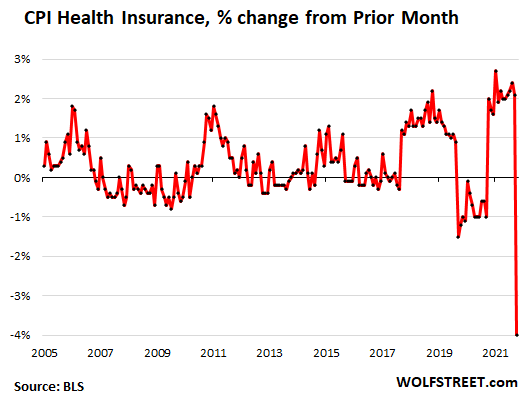
I think, at this moment, that Tech has saturated the wrong market, chasing the near term dollar. It has become invasive, by my reckoning, overrunning it’s skis and needs a reset.
So creative tech jobs are hardly dwindling. What’s dwindling are the salaries these gargantuan entities are willing to pay.
It’s the story of the senior geologist whose salary was quite high relative to the reservoir of new graduates in geology from almost every university. Why pay an old guy to tramp through the terrain gathering samples when he could be replaced with a naive, athletic, fresh grad.
Good luck to everyone that was terminated. I was there several times, it sucks. But it is, truly, water under the bridge.
After making a rather embarrassing number of questionable decisions to relocate to dismal locations for a job. I finally decided to adopt a Forrest Gump strategy. Wait for the honey pot to align with your current situation, given the potential I have to make a decision that is more exploratory than comfortable.
The future for America is robust.
Capitalism is anxious to get their honey pots back under the umbrella of America’s military might.
Since America is an industrial waste land, populated by the carcasses left to die by corporate America as they hired the communist Chinese to undercut American workers.
In the words of the inventor of the invisible hand of the free market:
“In regards to the price of commodities, the rise of wages operates as simple interest does, the rise of profit operates like compound interest.
Our merchants and masters complain much of the bad effects of high wages in raising the price and lessening the sale of goods. They say nothing concerning the bad effects of high profits. They are silent with regard to the pernicious effects of their own gains. They complain only of those of other people.”
― Adam Smith, An Inquiry into the Nature and Causes of the Wealth of Nations
Your email address will not be published.
Credit cards mostly a payment method, paid off monthly. Importance for borrowing declined over the years.
This inflation continues to dish up surprises.
As the FTX collapse shows, the shenanigans guarantee smooth and efficient contagion inside the crypto zone. But beyond it?
But there won’t be an adjustment for the Fed-favored “core PCE” price index that will come out before the next Fed meeting.
Binance-FTX deal now in doubt after revelations of huge black hole and investigations by the SEC and CFTC.
Copyright © 2011 – 2022 Wolf Street Corp. All Rights Reserved. See our Privacy Policy
