
guest column
All indications point to a fair amount of economic uncertainty in the coming months. I think a lot of B-to-B companies, across many industries, are going to retrench in their spending, and deals will likely be harder to close because more approvals will be required. Still, there are going to be those companies who will continue to grow because they are using the right go to market strategies and tactics.
Here are some of the things for high growth company management teams to consider doing.
A customer relations management, or CRM, tool is an essential component of data measurement — and every company needs to closely track those key performance indicators towards revenue and growth goals.
A CRM tool doesn’t have to be expensive. There are many low initial investment options such as Hubspot, SharpSpring, and others. The investment then becomes the staff or consultant time to set it up correctly so that it meets a company’s needs and to continue to monitor it.
How much time is spent depends on what you want the system to do. Some companies run their website out of a CRM platform, or send automated emails, or do their other social media through it. Others only use it to track their contacts and sales.
Data may show desired progress — or it may show stagnation — and a team needs to be able to analyze information expediently to reformulate a plan, or pivot to a new one, if needed.
While companies have a lot of different digital marketing tools at their disposal, there are five basic elements to consider optimizing. If the resources aren’t available to tackle them all at once, the management team needs to determine their top priorities.
Website design and content: Think about this as a company’s virtual lobby. A well-designed website with relevant content is essential for attracting new business. Ranking well in organic web searches — SEO — is also a very important component.
Social media: LinkedIn, with its business focus, is a great place to start. Companies can share their story, interact with potential investors, and build relationships with potential clients.
Email marketing: An email marketing newsletter is the logical step after developing a compelling company website. The content should benefit the reader. What can you do for them?
Content marketing: Blog posts, videos and ebooks are just some of the value added content you can share with potential investors and clients. What makes your company different from your competitors?
Paid advertising: Companies can use paid advertising to target potential new customers through online channels such as search engines and social media. The nice thing about paid advertising is that the attribution is there — companies can pinpoint exactly what messaging resonated with a potential client.
SEO and digital ads are not the solution for every company. Some companies need to make only a handful of deals each year to reach revenue goals. Broad-based digital marketing is not the best strategy for these players. What is? Often content.
The internet has given potential customers unparalleled ability to comparison shop. They want to know what a company does differently than its competitors. Whether a service or product is cheaper or faster or easier to work with. So tell them.
In addition to web content, speaking opportunities at conferences are a powerful way for companies to position themselves as differentiated in a given marketplace.
On the flip side, high volume players who require a lot of smaller deals would do very well with a far-reaching digital outreach approach.
No one is an expert in all areas. And they shouldn’t try to be. Whether that is financial analysis or digital marketing, hiring the right people to fill in any deficiencies is the smart move.
Trying to wing it through effort and good intentions is often frustrating for everyone. With digital marketing and lead generation, a lack of expertise can sometimes result in implementing a product or service that’s not really going to generate the expected results.
If a company spends big money on a digital marketing tactic, and it fails to land new business, then the assumption might be that digital marketing doesn’t work. That’s often not the case. It was simply the wrong tool for the job. An expert would help pinpoint the correct one.
Digital marketing should primarily be responsible for moving potential customers down the sales funnel. And sales revenue is the best evidence that the marketing was effective.
There has always been that push and pull with sales and marketing about what actions actually contribute to closing a deal but a good CRM tool will help.
There are other ways to measure the success of any campaign:
Continued growth starts with goal setting and coming up with a marketing and business development strategy that fits the unique needs of a business. This works most effectively when a company’s management team ensures that marketing and sales are working in lockstep. They are two sides of the same coin and need to see themselves that way to maximize results and therefore profit.
——
Libby Covington is partner at Houston-based The Craig Group, a strategic digital marketing solutions consulting firm. Her specialty is in understanding how sales and marketing work together effectively.
greentown updates
guest column
houston innovators podcast episode 170
Sparkle and Shine
ready for liftoff
Ty Audronis quite literally grew up in Paradise. But the Northern California town was destroyed by wildfire in 2018, including Audronis’ childhood home.
“That’s why it’s called the Campfire Region,” says the founder, who explains that the flames were started by a spark off a 97-year-old transmission line.
But Audronis, who has literally written the book on designing purpose-built drones — actually, more than one — wasn’t going to sit back and let it happen again. Currently, wildfire prevention is limited to the “medieval technology” of using towers miles apart to check for smoke signals.
“By the time you see smoke signals, you’ve already got a big problem,” Audronis says.
His idea? To replace that system with real-time, three-dimensional, multi-spectral mapping, which exactly where his company, Tempest Droneworx, comes in.
When asked how he connected with co-founder Dana Abramowitz, Audronis admits that it was Match.com — the pair not only share duties at Tempest, they are engaged to be married. It was a 2021 pre-SXSW brainstorming session at their home that inspired the pair to start Tempest.
When Audronis mentioned his vision of drone battalions, where each is doing a specialized task, Abramowitz, a serial entrepreneur and founder who prefers to leave the spotlight to her partner, told him that he shouldn’t give the idea away at a conference, they should start a company. After all, Audronis is a pioneer in the drone industry.
“Since 1997, I’ve been building multicopters,” he says.
Besides publishing industry-standard tomes, he took his expertise to the film business. But despite its name, Tempest is a software company and does not make drones.
That software is called Harbinger. Audronis explains that the real-time management and visualization solution is viewable on practically any device, including mobile or augmented reality. The system uses a video game engine for viewing, but as Audronis puts it, “the magic happens” on the back end.
Harbinger is not just drone-agnostic, but can use crowd-sourced data as well as static sensors. With the example of wildfires in mind, battalions can swarm an affected area to inform officials, stopping a fire before it gets out of hand. But fires are far from Harbinger’s only intended use.
The civilian version of Harbinger will be available for sale at the end of 2023 or beginning of 2024. For military use, Navy vet Audronis says that the product just entered Technical Readiness Level (TRL) 5, which means that they are about 18 months away from a full demo. The latest news for Tempest is that earlier this month, it was awarded a “Direct to Phase II” SBIR (Government Small Business Innovation Research) contract with the United States Department of the Air Force.
Not bad for a company that was, until recently, fully bootstrapped. He credits his time with the Houston Founder Institute, from which he graduated last February, and for which he now mentors, with many of the connections he’s made, including SBIR Advisors, who helped handle the complex process of getting their SBIR contract.
And he and Abramowitz have no plans to end their collaborations now that they’re seeing growth.
“Our philosophy behind [our business] isn’t keeping our cards close to our vest,” says Audronis. “Any potential competitors, we want to become partners.”
The company was just the two founders until five weeks ago, when Tempest’s size doubled, including a full-time developer. Once Tempest receives its SIBR check, the team will grow again to include more developers. They are currently looking for offices in the city. As Audronis says, Tempest Droneworx is “100-percent made in Houston.” Paradise may have been lost, but with Harbinger soon to be available, such a disaster need never happen again.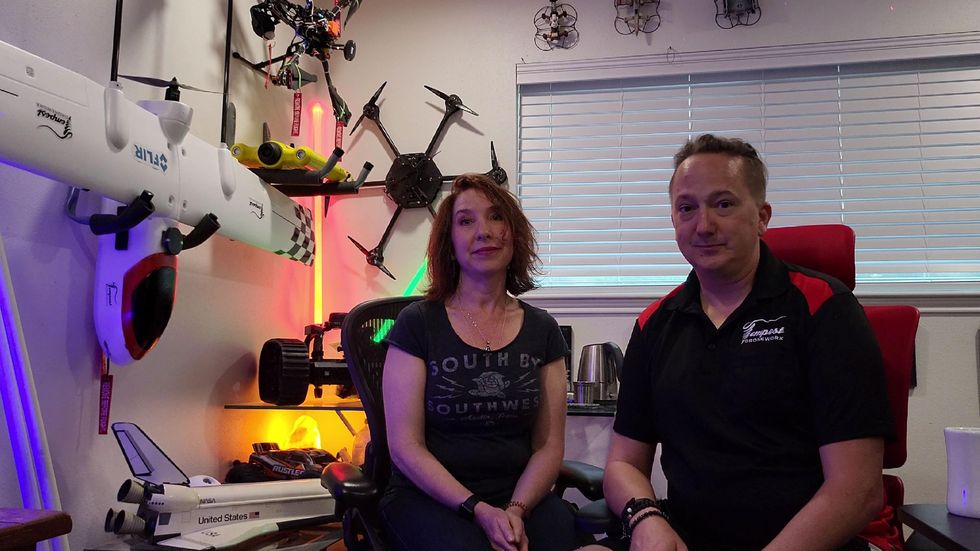 Dana Abramowitz and Ty Audronis co-founded Tempest Droneworks. Photo courtesy of Tempest Droneworx
greentown updates
guest column
houston innovators podcast episode 170